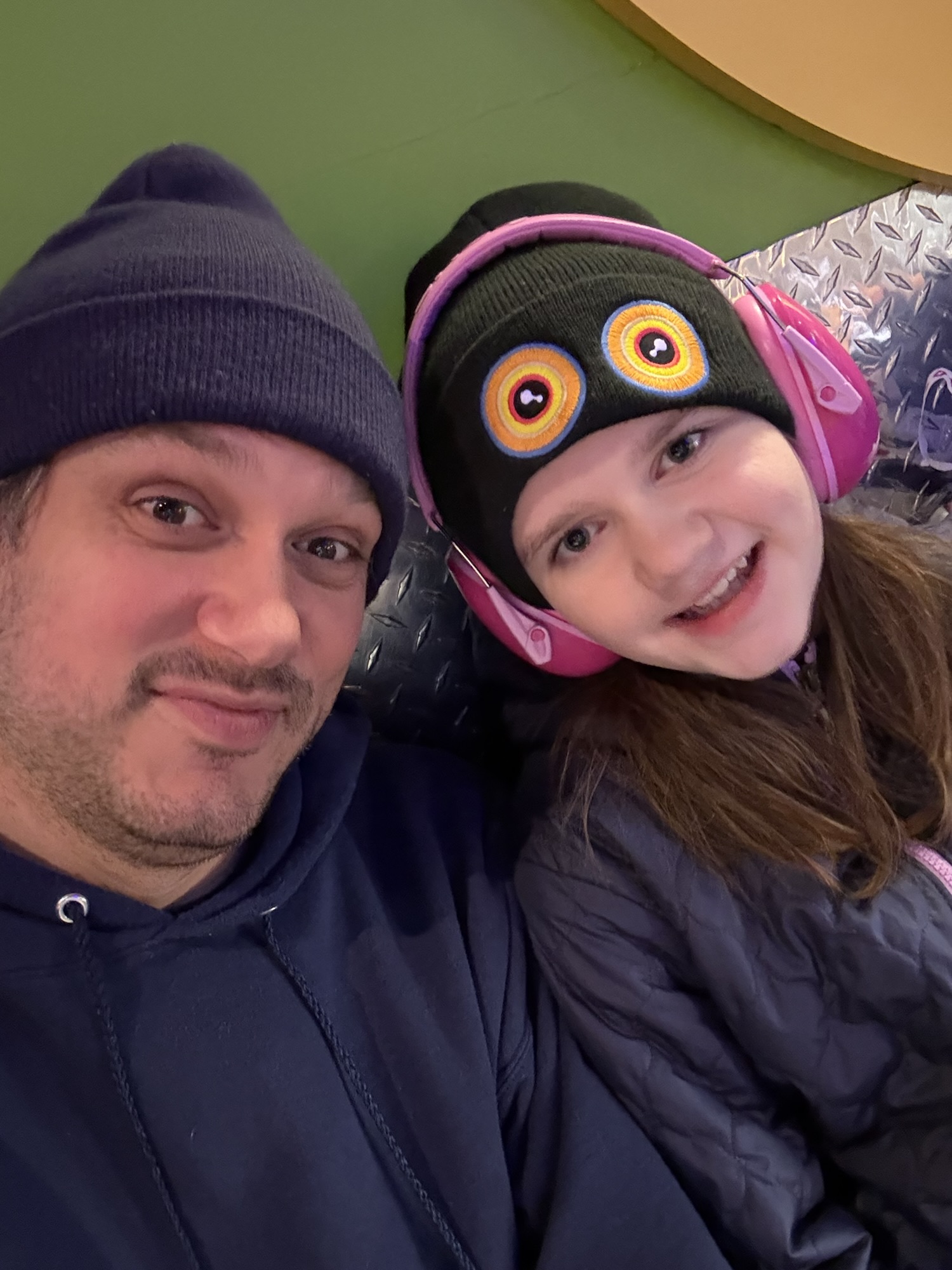
This year our daughter figured out how to navigate cooking on her own, just with prompts. She washed her hands, got the egg out of the fridge, she mixed the ingredients, and even flipped the food on the stove top. If you only knew her from her diagnostic paperwork, Level 3 autism, requiring “very substantial support”. You might not expect that kind of independence. In fact, I shared the video on Facebook and we received many comments along the lines of ‘there is no way she’s level three. My kid can’t do that.’
But here’s the thing, her diagnosis isn’t wrong. She does need very substantial support. She needs help with almost every activity of daily living. She can’t tell us when she’s hungry or hurt. She doesn’t understand what’s safe or dangerous. She experiences the world through a sensory system that sometimes feels like it’s set to a completely different frequency than everyone else’s.
I’m not arguing with her support needs. I’m questioning whether we’re correctly identifying what’s creating them.
The System We Have
When a child is diagnosed with autism today, they’re usually assigned one of three support levels. Sometimes written in different diagnosing language. The Level 1 means requiring support. These are kids who can communicate but struggle with social cues and transitions. Level 2 means requiring substantial support. Communication is more challenging, behaviors are more noticeable. Level 3, like my daughter, means requiring very substantial support. Often with limited or no speech, severe difficulty with change, and challenges that are obvious to anyone who spends time with the kid.
On paper, it makes sense. More support needs means more severe autism, right?
Maybe not.
The Divide This Creates
If you spend any time in autism parent groups or follow actually autistic advocates online, you’ve seen the fighting. Parents of Level 3 kids feel erased by a neurodiversity movement that centers the experiences of people who can speak for themselves. Self-advocates push back against parents who frame autism as tragedy and talk about their children suffering.
Both sides feel unheard. Both are fighting for visibility and resources for people they love. And both are arguing within a framework that might be fundamentally broken.
A Different Theory
What if Level 3 isn’t measuring “more autistic”? What if it’s measuring autism plus multiple other conditions?
Look at my daughter’s actual diagnoses:
• Autism Spectrum Disorder, Level 3
• Language disorder
• Dyspraxia
• Sensory Processing Disorder
• OCD
• Moderate Intellectual Disability
Her language disorder (not autism) is why she’s nonverbal. Her sensory processing disorder (a separate diagnosable condition) drives most of her sensory-seeking and sensory-avoiding behaviors. Her dyspraxia affects her motor planning and ability to complete tasks. Her OCD compounds the rigidity that autism already brings. Her intellectual disability makes it different for her to understand what is and isn’t safe. What is and isn’t socially acceptable.
Now here’s the uncomfortable question. If we could somehow remove those five comorbid conditions, would her autism alone still require Level 3 support? Or would it look more like what we call Level 1?
I’m not saying her support needs aren’t real. They’re profound. I’m saying we might be mislabeling what’s creating them.
We’ve Been Here Before
Our understanding of autism has never been static. The diagnostic criteria have been rewritten, subdivided, collapsed, and rewritten again. We used to have separate diagnoses. Autistic Disorder, Asperger’s Syndrome, PDD-NOS. The DSM-5 collapsed them all into one spectrum in 2013. The logic was sound, these were all variations of the same underlying neurodevelopmental difference.
But here’s what’s wild. Until that same DSM-5 update in 2013, a child couldn’t be diagnosed with both autism and ADHD. The manual specifically prohibited it. If you had autism and showed inattention or hyperactivity, those symptoms were assumed to be part of your autism, not a separate condition.
We know now that was wrong. Research shows that 50-70% of autistic people also have ADHD. These are distinct, co-occurring conditions. And when they occur together, they compound each other. The symptoms of each are more intense than they would be alone.
So for years, we were misattributing ADHD symptoms to autism. We were getting the diagnosis wrong. And kids weren’t getting the right support because we were treating the wrong thing.
What if we’re doing the same thing now with Level 3 diagnoses?
What This Would Mean
If I’m right, if Level 3 is often autism plus language disorder plus sensory processing disorder plus dyspraxia plus anxiety OCD, or intellectual disability, then we need to completely reframe how we talk about autism severity.
We’d stop comparing “autism severity” and start comparing total support needs. Because someone with Level 1 autism plus severe anxiety plus a sleep disorder might need just as much support as someone diagnosed Level 3. They’re just different constellations of need.
We’d stop the “who has it worse” debates, because we wouldn’t be measuring the same thing. A nonverbal autistic child and a hyperverbal autistic adult might both be equally autistic, just with completely different comorbidity profiles.
We’d direct research and resources toward the actual conditions creating the support needs. Want to help a child communicate? Target the language disorder with speech therapy and AAC. Want to reduce meltdowns? Address the sensory processing disorder with occupational therapy. Want to ease transitions? Work on the anxiety with appropriate therapeutic support.
And maybe, just maybe, we’d stop fighting each other long enough to demand better support for everyone.
What We Actually Need
I don’t have a better diagnostic system to propose. I’m not a researcher or a clinician. I’m a dad who’s watched my daughter’s team of therapists work on language, sensory regulation, motor planning, and anxiety management and watched those interventions help, while we all still call it “autism support.”
But I do know this, we’ve spent too long fighting over whose autism is “real” or whose challenges “count.” We’ve spent too long dividing into camps, neurodiversity versus medical model, Level 1 versus Level 3, suffering versus celebrating.
Meanwhile, kids and adults across the entire spectrum still can’t get the services they need.
What if we stopped asking “how autistic is this person?” and started asking “what does this person need to thrive?”
What if we recognized that every autistic person’s constellation of needs is unique, not because autism exists on a linear severity scale, but because autism rarely shows up alone?
What if we built support systems around actual needs instead of diagnostic labels?
I don’t know if my theory is right. I know that our understanding of autism has changed dramatically over the past 80 years, and I don’t think we’re done evolving yet. I know that the Level 3 designation helped my daughter access services, and I’m grateful for that. But I also know that when I look at what actually helps her day-to-day, most of it isn’t autism intervention. It’s language support, sensory regulation, motor planning, and anxiety management.
Maybe that’s the point. Maybe we’re still getting the diagnosis wrong, just in a different way than we used to.
Or maybe, and this is what I really hope, maybe by questioning these frameworks, we can finally move past the infighting and toward something better. Toward a world where every autistic person gets support that actually fits their needs, without having to prove their autism is “severe enough” or “real enough” or any other arbitrary measure that pits us against each other.
Because at the end of the day, my daughter doesn’t need me to argue about how autistic she is. She needs me to fight for the specific supports that help her communicate, regulate, and engage with the world on her terms.
And I’m pretty sure that’s what every autistic person deserves, regardless of their level.
 The Wee Family
Hi wee fam I have autism too but it’s ok I also have operational defient disorder,attention deficit disorder, depression, anxiety,I am also missing a chromosome,small scale of skulliosis in my back,syatic nerve pain in my leg,risk for brain aneurisms,risk for strokes to my second heart surgery at 15 ! So I love braylee xoxo just know u are not alone girly
LikeLiked by 1 person